
ACCREDITATION: Panic is Optional
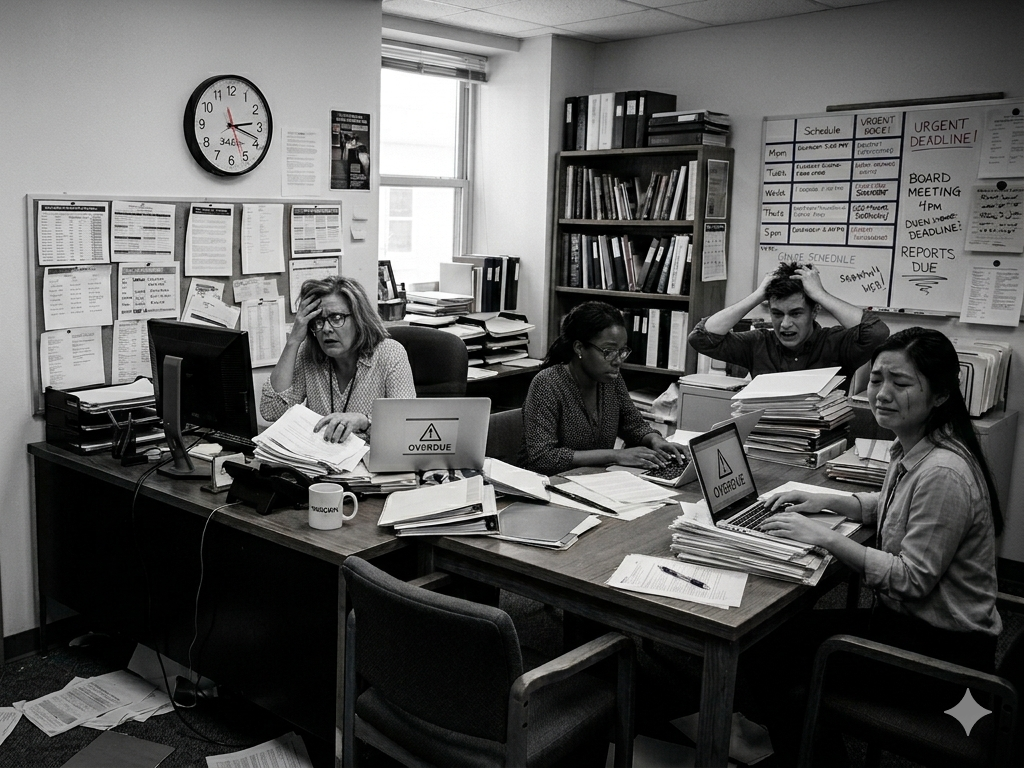
If you are doing what you say you are doing, and you have the evidence to support it, where is the anxiety coming from?
By incorporating accreditation foundations into your day-to-day work it makes preparing for a review, whether it is today or 3 years from now, a breeze.
This article examines best practices in four critical areas of the accreditation process: standards, self-assessment, narratives and evidence.
“DONE” ISN’T THE SAME AS “DEMONSTRATED”
Before diving into any part of the accreditation process, it is critical to spend meaningful time with the standards themselves to interpret them fully and understand their intent. Equally important is the question guiding the work. Are teams asking, “Do we have this?” or “What does this look like in practice at our school?” That distinction has a significant impact on the quality and credibility of both the self-assessment and the accompanying narratives.
A checklist mindset, focused solely on whether something exists or not, often leads to collections of disconnected documents and narratives describing activity rather than impact. While this may feel thorough, it misses the core purpose of the standards, which is to evaluate how well a school operates as a cohesive, interconnected system. When standards are treated in isolation, opportunities to demonstrate alignment are missed. For example, how leadership decisions influence instructional practice, which in turn influence student outcomes.
Review teams are not simply looking for confirmation that systems exist. They are looking for evidence that those systems work together effectively and produce meaningful, measurable results. That story cannot be told convincingly unless the standards are fully comprehended and thought is given to how each plays upon the next.
SLOW DOWN: THIS PART MATTERS
Unfortunately, the self-assessment is often treated as a preliminary task that is rushed through to get to the perceived “real work” of gathering evidence and drafting narratives. In reality, the self-assessment is the driving force behind all the work that comes after. It paints a picture of the institution’s current state and focuses efforts for the rest of the review. By rushing through the process, it sends a message that reflection is not a strength of the institution and can immediately weaken the integrity of the entire accreditation process.
When completing the self-assessment, it is important that criteria be evaluated based on evidence, not intention. Every rating should be anchored in current, verifiable data and distinctions be made between systems that are still developing and those that are fully implemented. Language such as “we plan to” or “we typically” is a cue to pause and look deeper. Accreditation teams are assessing what is actually happening, not what is hoped for or assumed.
This work also cannot live with a single person. A meaningful self-assessment is strongest when it is approached as a strategic exercise involving a cross-section of school leaders and key stakeholders. Does this require time and dedication? Yes. But by pulling together people close to the work who are able to engage in thoughtful, honest conversations about what is working and what still needs attention, the insights become invaluable. This shared ownership deepens the accuracy of the assessment ratings and, perhaps most importantly, strengthens the commitment to improvement.
SHOW. THEN TELL.
Stop drafting narratives before gathering evidence.
Writing narratives first and then scrambling to find documentation to support what is claimed is a recipe for chaos. Narratives approached in this manner often rely on strong-sounding language about intentions and future plans but lack concrete examples proving their consistent and sustainable implementation. As a result, they fall apart under review because they are built on assumptions rather than verified practice.
Start by organizing evidence that demonstrates current practice and documented impact. Only then should a narrative be drafted to explain what the evidence shows, including areas that are still in progress. Be cautious of phrases like “we ensure,” “we prioritize,” “we are committed to.” These statements sound confident but lack real substance. Instead, be specific. Refer to the evidence, documented impact, and specific examples.
The strongest accreditation narratives grow directly out of the evidence.
ASSIGN ACCOUNTABILITY
One of the most effective ways to remain accreditation-ready is to assign accountability. A practical starting point is to begin with the evidence itself. Once strong evidence is identified, each item should have a clearly defined owner responsible for ongoing review, updates, and alignment with current initiatives, the school’s mission, and prior accreditation feedback. Without assigned ownership, even high-quality evidence can quickly become outdated or disconnected from day-to-day practice.
Evidence owners are accountable for continued data collection, analysis, discussion, and adjustment. This does not mean adding an unmanageable workload. If approached thoughtfully, this evidence is already in existence, and ongoing management can be built into standing meetings and existing reporting structures. Over time, this approach strengthens the evidence and establishes a clear trail of trend data for the next review, which in turn results in more compelling and credible narratives.
Simple tools, like an Accreditation Evidence Tracker, can offer the structure needed to sustain this approach. Ownership is clear and progress is visible. This helps schools maintain momentum and avoid accreditation anxiety.
IF YOU REMEMBER NOTHING ELSE
Standards: Show how the work connects and drives impact, not just that systems exist.
Self-Assessment: Don’t rush it or do it alone. Use real evidence and real voices to arrive at honest ratings.
Narratives: Let the evidence drive the story, not the other way around.
Evidence: Assign owners to your evidence and keep it updated.
