
THE MOST LAST-MINUTE ACCREDITATION STRESS
5 DOCUMENTS CAUSING SCHOOLS THE MOST LAST-MINUTE ACCREDITATION STRESS: And Practical Ways to Make Documentation Easier
When it comes to accreditation, it is rare that a school is missing the actual work. Strategic conversations are happening. Stakeholder feedback is being collected. Professional Development is scheduled. And data, oh so much data, is being reviewed.
What is missing is the trail of evidence showing not only that these activities happened, but how they contributed to continuous improvement.
Below, in no particular order, are five areas that seem to create the most last-minute scrambling.
1. Stakeholder Survey Results.
Schools are getting better and better at gathering feedback from families, students, and staff. The problem is in documenting what happened next.
When schools can show, “Here is what the stakeholders told us, and here is what we did in response,” they create some of the strongest evidence possible. It also reinforces future participation because stakeholders can see their feedback resulted in meaningful action.
2. Staff Evaluation Records
Most schools conduct evaluations. The challenge is demonstrating that the process is consistent and followed by meaningful growth conversations.
Reviewers should be able to easily see that evaluations were completed, goals were established, progress was monitored, and follow-up occurred.
3. Professional Development Evidence
Attendance sheets. Check.
Not quite.
Simply attending a Professional Development does not demonstrate impact. The most effective evidence tells a story:
Why was the training provided?
What was expected to change?
How did staff apply the learning?
What impact was observed?
Schools invest significant time and resources into professional development. Capturing the results helps demonstrate the return on that investment.
4. Student Performance Data
No one is suffering from a shortage of data these days. The struggle is organizing it in a way that shows regular review, analysis, and action.
When leadership can document regular discussions around student outcomes, interventions, attendance, graduation indicators, and program effectiveness, they not only create strong evidence of continuous improvement but, more importantly, they reinforce systems that prioritize data-driven decision-making.
5. Strategic Planning Evidence
Anyone can draft a strategic plan. It’s when you are asked to demonstrate how that plan influenced decisions made throughout the year that causes panic.
Can you show where strategic goals were discussed? Was progress monitored? What adjustments were made when something wasn’t working?
The Strategic Plan should be referenced regularly and guide conversations and priorities.
——————————————————————
None of the items on this list are likely surprising.
The good news is that addressing them doesn’t require creating a whole new set of systems.
Think about how you support students. You don’t wait until final grades are posted to find out whether learning is happening. You monitor progress, review data, make adjustments, provide support, and measure results throughout the year.
Accreditation should follow the same approach.
You don’t necessarily need to do more work, you simply need to document the work you are already doing: a quick note from a leadership meeting, a strategic plan adjustment, summary of survey feedback, a record of actions taken after a data review.
PRACTICAL WAYS TO MAKE DOCUMENTATION EASIER
BUILD IT INTO YOUR MEETING MINUTES
Most leadership teams already review key areas during routine meetings. Instead of having those discussions disappear into a generic set of meeting notes, add standing agenda items tied to continuous improvement goals and document decisions made, action steps, and follow-up plans.
Example:
Strategic Goal 1
Discussion Summary
Decision Made
Action Steps
Responsible Party
Progress Update
By the end of the year, your meeting minutes become a timeline of improvement efforts.
TURN EXISTING DASHBOARDS INTO EVIDENCE
Most schools already maintain dashboards, scorecards, enrollment reports, and board updates. Rather than creating separate accreditation documents, add a section called “Actions Taken” or “Improvement Efforts.”
It is one thing to report that attendance decreased by 3%. It is another thing entirely to document that leadership discussed the trend, identified root causes, implemented outreach strategies, and saw improvement the following quarter.
Example:
Data Reviewed --> Action Taken --> Date --> Outcome
This moves beyond simple data and becomes evidence of continuous improvement.
CREATE AN EVIDENCE FOLDER
One of the biggest mistakes schools make is treating accreditation evidence as a major project every few years.
Instead, create a shared repository where documents can be saved throughout each school year. Presentations, survey summaries, strategic plan updates, data review notes, and program evaluations are already being produced. They simply need a consistent place to live.
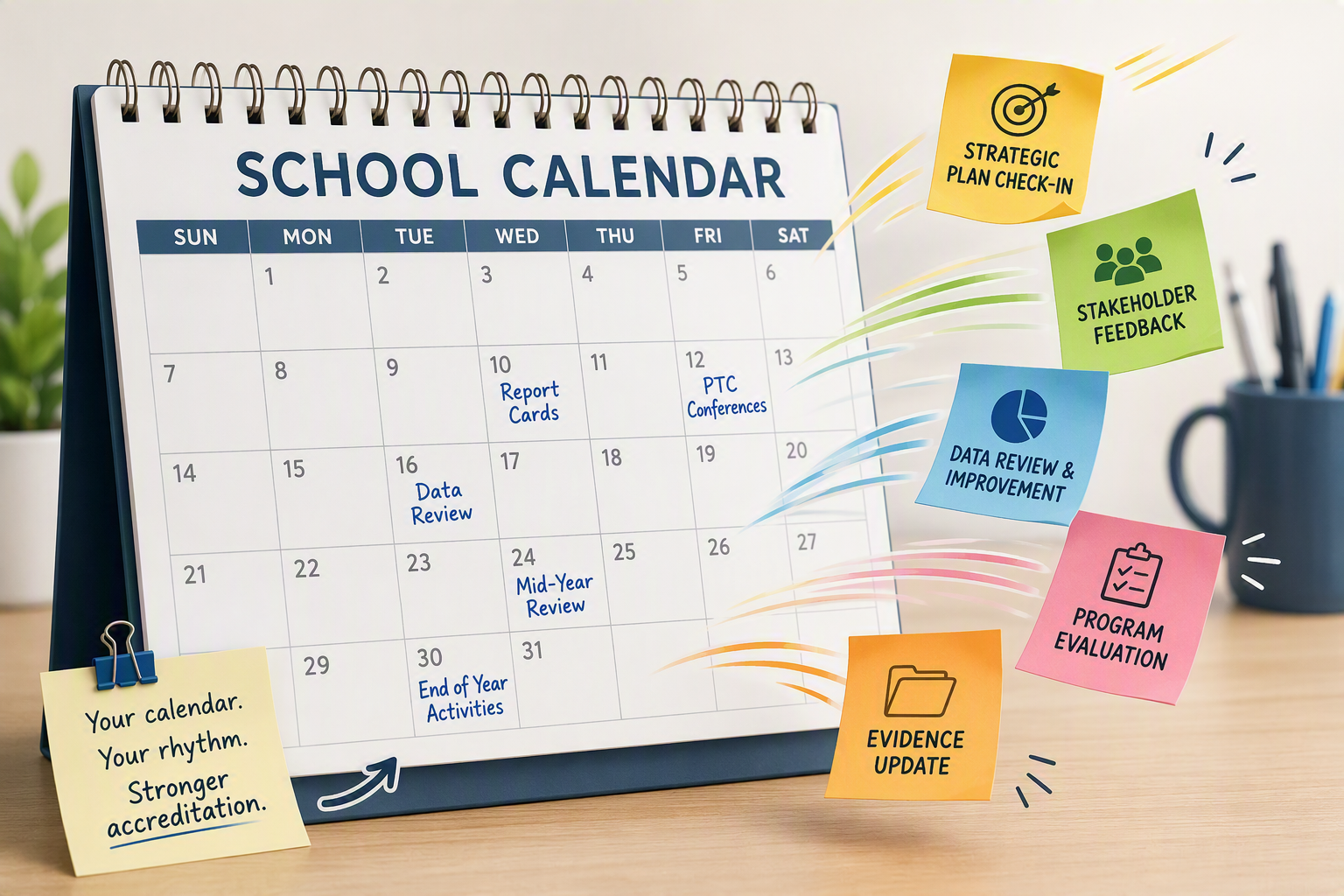
USE THE SCHOOL CALENDAR AS YOUR ACCREDITATION CALENDAR
Schools already operate on predictable cycles. Use them to your advantage by attaching one accreditation-related activity to each existing milestone. For example, during mid-year academic reviews, review strategic plan progress. During end-of-year reflections, document program effectiveness and improvement priorities. During survey cycles, record and share action taken in response.
Let accreditation follow the natural rhythm of your school year.
Schools that experience the least accreditation stress aren’t doing dramatically more than everyone else. They are simply capturing the conversations, decisions, and improvements as they are happpening and doing it consistently throughout each school year.
